It happens all too often a business owner launches a brand-new website, admires it for a few weeks, and then forgets about it entirely. But unlike a printed brochure, a website isn’t something you can set and forget. Without regular updates and attention, even the most visually appealing website will fail to deliver results.
To achieve lasting success online, your website needs consistent care and optimization. Not sure where to start? In this blog post, we’ll show you how to use WOC (Website Optimization Cycle) to continuously improve your website’s performance and keep it working hard for your business.

Why Your Website Is Never Finished
You might think, “My website is live, so it’s finished.” Actually — not quite. Your site may be ready to showcase to your customers, but that doesn’t mean your work is done. A truly great website isn’t a one-time project — it’s an ongoing process.
“Your website is never finished, because there is no such thing as a perfect website.”
Just like your business, your website needs to evolve continuously. Below are five key reasons why it’s essential to keep improving your website regularly.
1. Your Products or Services Evolve
Your offerings won’t stay the same forever. New products launch, older ones phase out, and your messaging may change over time. You might receive fresh customer testimonials or want to refine how you present your product’s benefits. Each of these updates is a reason to refresh your website content and keep it relevant.
2. Competition Keeps Growing
New competitors enter the market all the time — and existing ones are constantly improving their digital presence. To maintain your edge and continue attracting customers, you need to update your website strategy, design, and SEO regularly.
3. The Online Environment Changes
The way people use the internet is always evolving. For example, older generations are now more active online, often requiring simpler layouts and clearer navigation. Adapting your website to meet changing user behaviors and demographics ensures that it remains accessible and effective.
4. Laws and Regulations Are Updated
As a website owner, it’s your responsibility to comply with the latest regulations — such as data privacy laws (remember the impact of GDPR?). Ignoring these changes can lead to penalties or loss of trust. Regular website updates ensure you stay compliant and protect both your business and your customers.
5. The Web Keeps Innovating
Technology moves fast — and the web is no exception. Over the past decade, we’ve seen major shifts, from responsive design to mobile-first browsing. More people now use smartphones as their primary way to visit websites. Keeping up with design trends, performance standards, and technical innovations ensures your site remains modern and user-friendly.
Continue with Your Old Website or Start Fresh?
Now that you understand why continuous improvement is essential, the next big question arises:
Should you keep updating your current website, or is it time to start over with a brand-new one?
The answer depends on several key factors. Before making a decision, ask yourself the following questions:
1. Is Your Website Flexible Enough for Major Updates?
Consider whether your existing website platform can handle larger updates or new functionality.
If your current setup limits what you can do — such as adding new features, integrating tools, or improving performance — it may be more efficient to start fresh with a modern, scalable framework.
2. How Well Does Your Website Rank on Google?
Search rankings play a big role in your decision.
If your current site doesn’t rank well in Google, redesigning or rebuilding it carries little SEO risk and could help improve visibility.
However, if your website already performs strongly in search results, proceed carefully. Make sure any redesign or migration preserves your existing SEO value and doesn’t harm your ranking.
3. Does Your Website Still Look Modern and Appealing?
First impressions matter. If your website looks outdated — slow load times, cluttered layouts, or a design that feels “stuck in the past” — it’s probably time for a new one. Modern users expect clean, responsive, and mobile-friendly designs that reflect your brand’s credibility.
If, after considering these questions, you conclude that your website is good enough for the next one to two years, that’s great news! It means you can focus on systematic improvements — refining design, updating content, and optimizing performance to stay current.
Keep reading, and I’ll walk you through the next steps to continuously enhance your website using the WOC (Website Optimization Cycle).
The 5 Phases of the Website Optimization Circle (WOC)
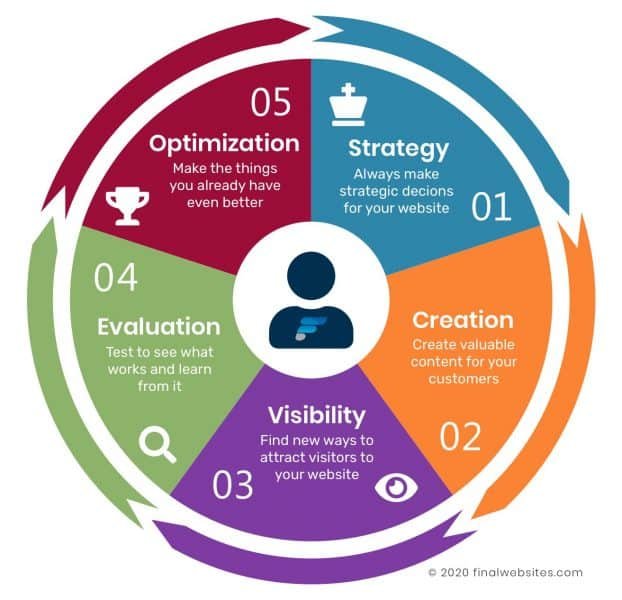
The Website Optimization Circle (WOC) consists of five key phases: Strategy, Creation, Visibility, Evaluation, and Optimization. Working on each of these phases consistently will help you achieve better results and long-term success.
Important:
The WOC isn’t a linear guide you follow from start to finish. Instead, focus on the phases that matter most to your website at any given time. However, don’t skip any phase permanently — every one of them plays a vital role in your website’s success.
Below, we’ll explore each phase in detail.
1. Strategy: Make Every Decision with Purpose
Whatever change you make on your website should be guided by strategy. This doesn’t mean building a full-fledged online business strategy — it means working strategically and purposefully at every step.
You should always know what you’re doing and why.
That means no content without a goal, no “call to action” without intent, and no modification without solid reasoning.
Examples of Strategic Focus Areas:
-
Content marketing
-
Email marketing
-
Social media marketing
-
Advertising
-
Customer journey
-
User experience (UX)
-
Brand voice & tone
-
Call-to-action design
-
Trust-building & credibility
3 Tips for Strategic Decision-Making:
-
Start with a goal.
Don’t just start blogging or posting on social media without a clear purpose. Every step should have a measurable objective. For example, if your product isn’t widely searched, identify related keywords your audience does use and create content around them. -
Analyze your competitors.
Researching your competition gives valuable insight into what your audience expects. Review local and international competitors to understand trends — and then differentiate yourself. -
Keep it simple.
You don’t need a complex strategy right away. Begin by fixing the basics: missing CTAs, weak keywords, or outdated automated emails that don’t convert.
2. Creation: Develop Valuable Content for Your Customers
Many business owners mistakenly focus their websites on their company — their products, mission, or team. While that information matters, your website should primarily serve your customer’s needs.
Focus on answering visitors’ questions and solving their problems. Your content should add value through:
-
Blog posts
-
Service pages
-
Social media updates
-
Email newsletters
-
E-books or guides
3 Tips for Creating Meaningful Content:
-
Don’t fear transparency.
Sharing your expertise sets you apart. Go beyond generic content — create resources that are more detailed, insightful, and useful than what your competitors offer. -
Create evergreen content.
Focus on information that stays relevant over time. Avoid excessive focus on short-lived news updates. -
Repurpose your content.
Turn blog posts into newsletters, and share snippets as social media posts. Consistent messaging across platforms strengthens your online presence.
3. Visibility: Increase Your Reach and Attract the Right Audience
Having thousands of followers or visitors means little if no one engages or converts. It’s not just about traffic — it’s about quality and relevance.
Visibility efforts help you attract new visitors and bring existing ones back.
Ways to Improve Visibility:
-
Boost your SEO performance
-
Advertise on search engines or relevant platforms
-
Send newsletters regularly
-
Collaborate with influencers or partner websites
-
Run offline marketing campaigns
3 Tips to Enhance Visibility:
-
Understand your target audience.
Know their search habits, favorite channels, and the brands they follow to create better-targeted campaigns. -
Stay consistent with your brand identity.
Use your logo, colors, and voice across all communications to build instant recognition. -
Be authentic and honest.
Audiences can sense when messages are insincere. Balance promotion with helpful, genuine content that builds trust.
4. Evaluation: Test and Analyze What Works
A website with many visitors isn’t automatically successful. If users can’t find what they need or don’t take action, your site isn’t performing effectively.
While A/B testing is popular, it often requires large traffic volumes. Small businesses can still evaluate performance through:
-
Website analytics
-
Customer reviews and feedback
-
Competitor analysis
3 Tips to Evaluate Effectively:
-
Avoid assumptions.
Don’t jump to conclusions about user behavior. Make small, measured changes and track results. -
Track all conversions.
Even if you’re not an online store, measure form submissions, newsletter sign-ups, and button clicks to understand engagement. -
Focus on user experience.
Your preferences matter less than your visitors’. Design your site for clarity, usability, and speed to meet user expectations.
5. Optimization: Make What Works Even Better
Once you’ve identified what’s effective, it’s time to refine and enhance it. But beware of over-optimization — more isn’t always better.
Many business owners clutter their pages with excessive CTAs or pop-ups, which often frustrates users and drives them away.
3 Tips for Smart Optimization:
-
Focus on quality, not quantity.
Improve existing conversion elements instead of adding new ones everywhere. -
Prioritize usability.
Simplify your design and guide users toward key actions. -
Iterate continuously.
Optimization is never “done.” Regularly test, refine, and adjust based on performance data.
Improve Your Website Strategically with the WOC
Your ultimate goal is to enhance your website strategically — and the Website Optimization Circle (WOC) helps you do just that. Each phase of the WOC connects with the others, ensuring your website grows in a balanced and effective way.
Here are some key areas you can optimize for better performance and results:
-
Call-to-actions (CTAs)
-
Content quality and structure
-
Technical performance / website speed
-
User experience (UX)
-
Sales funnel
-
Brand experience
-
Mobile responsiveness
-
Accessibility
3 Tips to Improve What You Already Have
Improving your website is an ongoing process, and every area requires a slightly different approach. Here are three practical tips to get started:
-
Make gradual changes.
Avoid making too many updates at once. If you implement several changes simultaneously and the results aren’t as expected, you won’t know which one caused the issue. Optimize step-by-step so you can identify what works best. -
Prioritize mobile optimization.
Many website owners still overlook how their sites perform on mobile devices — even though most users browse on their phones. Design your site mobile-first, ensuring every element looks great and functions smoothly on all screen sizes. -
Get a professional review.
Not sure where to start? Ask a web expert to review your site. Many companies offer free website audits or basic checks — a great way to discover improvement opportunities before investing in a full redesign.
How to Use the WOC
The five phases of the Website Optimization Circle — Strategy, Creation, Visibility, Evaluation, and Optimization — can be applied individually or together to strengthen your website’s performance.
Here’s how these phases work in real-world scenarios:
-
Strategy + Creation:
You set a goal to collect email addresses from potential customers (strategy phase) and decide to create a free email course to attract sign-ups (creation phase). -
Creation + Visibility:
You publish a new blog post (creation phase), but it’s not ranking on Google. You then write a guest post on another website linking back to yours (visibility phase). -
Visibility + Evaluation:
You regularly send newsletters (visibility phase), but you’re unsure which topics perform best. So, you analyze click data to see what your audience prefers (evaluation phase). -
Evaluation + Optimization:
Your page ranks in Google’s top 3 results for a popular keyword, but few people click on it. You adjust the page’s title and meta description to increase the click-through rate (optimization phase). -
Optimization + Strategy:
You’ve improved several blog posts for SEO (optimization phase), and they’re now attracting more visitors. Next, you plan new CTAs and content strategies to boost conversions (strategy phase).
These examples show how each phase connects — and how continuous improvement becomes second nature once you start using the WOC.




No comment